Treatment Services (Cognitive-Behavior Therapy)
Navigating the Transition: Specialized Cognitive Behavior Therapy for Neurodivergent Young Adults (Ages 18–24)
The transition into adulthood—navigating higher education, entering the workforce, and building independence—presents unique challenges for those with neurodevelopmental disorders (such as Autism Spectrum Disorder, ADHD, and learning differences).
Standard therapeutic models often fail to account for different cognitive profiles. Our practice bridges this gap by offering specialized Cognitive-Behavioral Therapy (CBT) that is grounded in the latest research and tailored specifically for the neurodivergent brain. Our specialized CBT is specifically designed for young adults (18–24) who are managing neurodevelopmental needs alongside co-morbidities like anxiety, depression, or OCD.
 State-of-the-Science, Evidence-Based Care
We don’t just provide therapy; we provide clinical interventions backed by the latest research. Our approach is consistent with the “state of the science” for neurodevelopmental care in 2026, utilizing adapted CBT protocols shown to be effective for individuals with diverse cognitive profiles.
- Adapted Protocols: Traditional CBT is modified to include visual aids, structured session agendas, and explicit skill-building to address executive functioning.
- Targeting Co-Morbidities: We utilize evidence-based strategies to treat the “co-morbid” conditions that often accompany neurodivergence, such as social anxiety, OCD, depression, and chronic stress.
- Neuro-Affirming Lens: Our research-driven methods focus on functional goals and self-advocacy.
 The Foundation: Comprehensive Evaluation
Effective treatment begins with an accurate map. Before therapy starts, clients undergo a thorough diagnostic evaluation to ensure a full understanding of their unique strengths and challenges, as well as ensure accurate diagnosis.
Our evaluation process includes:
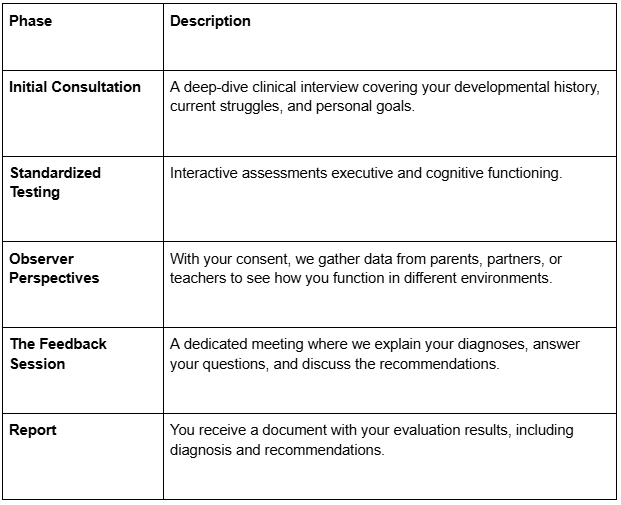
- Clinical Intake: An in-depth review of developmental, academic, and social history.
- Diagnostic Testing: Use of gold-standard assessment tools to confirm primary diagnoses and identify co-occurring conditions.
- Functional Assessment: Evaluating executive and cognitive functioning, as well as adaptive living skills.
- Feedback & Blueprinting: A dedicated session to review findings and discuss individualized treatment recommendations tailored to your specific “cognitive fingerprint.”
 Individualized & Expert-Led Services
Your brain doesn’t work like everyone else’s, so your therapy shouldn’t either.
Expert Providers
Our clinicians are not generalists; they are specialists in neurodevelopmental disorders. We stay at the forefront of clinical research to ensure our clients receive the most sophisticated care available.
Flexible Modalities: Individual & Group-Based Treatment
We recognize that for young adults with neurodevelopmental differences, “effective” therapy must be as flexible as it is evidence-based. Depending on your goals and the findings of your initial evaluation, we offer two primary modalities—often used in combination—to ensure the best clinical outcomes.
Individual CBT: The Personalized “Deep Dive”
Individual sessions provide a private, highly focused environment where we can tackle the nuances of your specific “cognitive fingerprint.”
- Targeted Strategy Building: Focus exclusively on your unique executive functioning hurdles, sensory triggers, or specific anxiety patterns.
- Pacing Control: We adapt the speed of information delivery and session structure to match your processing style.
- Safe Exploration: A space to discuss sensitive topics—such as workplace accommodations or relationship challenges—with a dedicated expert.
Group-Based Treatment: The “Social Laboratory”
Neurodivergent young adults often experience a sense of “otherness.” Our group sessions are designed to counteract isolation while providing a structured environment to build real-world skills.
- Lived Experience & Universality: Connect with peers who “get it.” This reduces the shame often associated with neurodivergent challenges and fosters a sense of community.
- Real-Time Social Practice: Groups provide a safe, expert-led space to practice self-advocacy, perspective-taking, and social navigation in real-time.
- Peer Modeling: Witnessing how others implement evidence-based strategies provides powerful motivation and practical “proof of concept.”
Flexible Service Frequency
Treatment intensity is never “one size fits all.” Frequency is determined by your presenting concerns and clinical needs.
- High-Support Phases: Weekly or bi-weekly sessions during major life transitions or periods of high distress.
- Skill-Building Phases: Consistent weekly sessions focused on developing specific tools.
- Maintenance: Monthly “check-ins” once goals are stabilized to ensure long-term success.
Integrated Family Components
For young adults (18–24), the “launching” process often involves the family system. When appropriate—and with the client’s full consent—we integrate family sessions to provide education, improve communication, and ensure the home environment supports the client’s burgeoning independence.
Ready to Start?
Take the first step toward a treatment plan that actually understands how you think.
Take the first step!
Please note we are no longer able to accept new patients 25 years and older for treatment services. We recommend you contact your insurance carrier to obtain a list of providers/agencies that participate with your plan.
Neurodevelopmental Diagnostic Evaluations
Comprehensive Neurodevelopmental Services for Young Adults (Ages 18–24)
The transition into your twenties is a high-stakes era of life. Whether you are navigating school, entering the workforce, or establishing independence, the “cognitive load” of adulthood can be overwhelming.
Our clinic specializes in providing diagnostic clarity for young adults, whether you are seeking answers for the first time or looking to update a childhood diagnosis that no longer fits your adult reality.
Two Paths, One Goal: Clarity
We meet you exactly where you are in your journey of self-discovery.
1. The Initial Discovery (New Diagnosis)
If you’ve spent years feeling like you’re working twice as hard as your peers to achieve the same results, you may be navigating an undiagnosed neurodivergent brain. We help identify ADHD, Autism, and Learning Differences that were missed in childhood—often because of high intelligence or the ability to employ compensatory strategies.
2. The Advanced Refinement (Existing Diagnosis)
A diagnosis made at age seven often lacks the nuance needed at age twenty. We provide updated evaluations for those who already have a label but feel “stuck.”
- The Neurodevelopmental Intersection: Investigating the common overlap between Autism and ADHD.
- Evolution of Needs: Translating childhood symptoms into adult challenges like executive dysfunction, workplace sensory triggers, and “Autistic Burnout.”
- Documentation for the Services: Providing the updated clinical report required for accessing services.
Our Evaluation Framework
We don’t just hand you a label; we provide a “user manual” for your specific brain. Our process analyzes the complex interplay between your cognitive strengths and the barriers in your environment.
Our assessments dive deep into:
- Executive Functioning: Mapping how your brain plans, prioritizes, and manages time.
- Social & Emotional Nuance: Moving beyond basic social skills to understand your unique communication style and the internal cost of “masking.”
- Cognitive Profiling: Identifying your processing speed, working memory, and verbal vs. non-verbal reasoning.
- Medication Effectiveness: Assessing the effects, both intended and adverse, of stimulant medications.
Our Specializations
We provide deep-dive diagnostic clarity for a range of neurodevelopmental profiles:
- ADHD (Attention-Deficit/Hyperactivity Disorder): Beyond simple “distractibility,” we look at executive function, emotional regulation, and cognitive processing.
- Autism Spectrum Disorder (ASD): Focusing on the adult presentation of Autism, including sensory processing, social communication styles, and “camouflaging” behaviors.
- Learning Disabilities (Dyslexia, Dysgraphia, Dyscalculia): Identifying specific barriers to reading, writing, or mathematics to secure necessary workplace or testing accommodations (like the GRE, LSAT, or MCAT).
- Executive Functioning Profiles: Mapping how your brain plans, prioritizes, and executes tasks.
**See additional Assessment Tab for other available assessment options**
The Evaluation Process: What to Expect
We move beyond simple checklists to provide a holistic view of your cognitive and emotional landscape.
Virtual ADHD Evaluations
A virtual ADHD evaluation is a comprehensive clinical assessment conducted via secure, HIPAA-compliant video conferencing. It follows the same diagnostic gold standards as an in-person visit but removes common “executive function barriers”—like commuting, navigating a new office, or sitting in a fluorescent-lit waiting room.
Evaluations for Testing Accommodations
We don’t just hand you a report and wish you luck. Our team understands the nuances of the Americans with Disabilities Act (ADA) as it applies to testing. We ensure your report uses the specific clinical language required to satisfy legal and medical reviewers.